
How to Quit Social Media, The New Cigarette
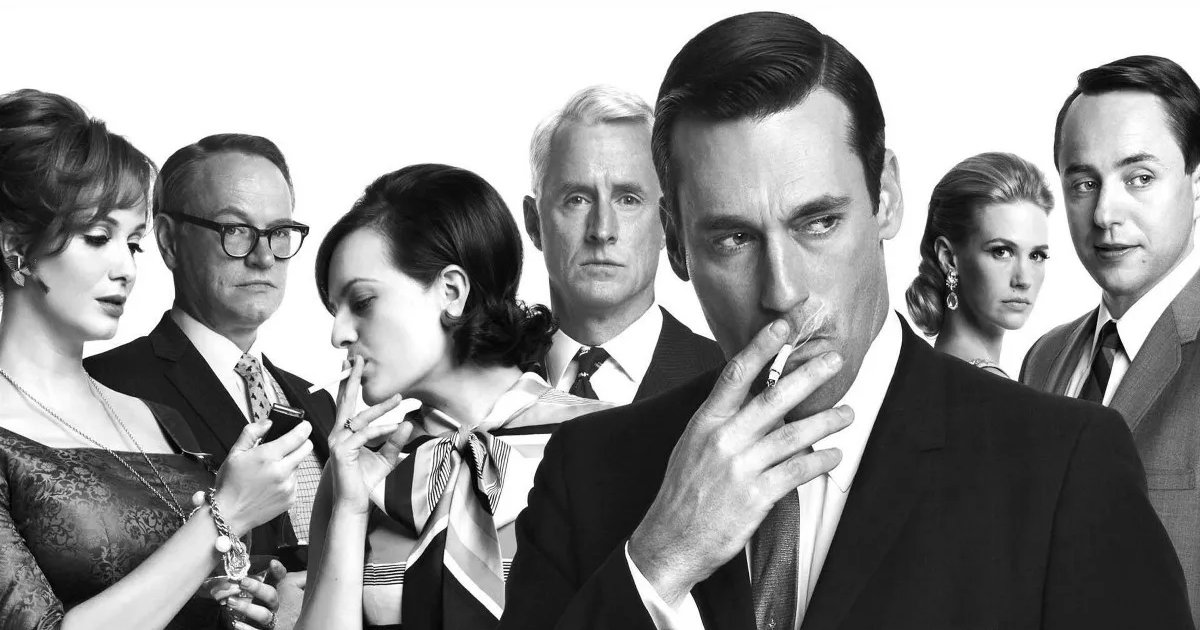
While watching Mad Men, a drama set in the 1960s,1 I couldn’t help but notice how smoking was everywhere. People smoked at home, the office, airplanes, restaurants, and even hospitals. Back then, cigarettes weren’t just a habit; they were a lifestyle. Cigs made you look sharp, successful, and in control.
But in hindsight, we know the truth: it was an addiction hiding behind a cloud of smoke.
That’s exactly how I see social media today. We treat it like it’s essential, like we need it to stay connected, stay relevant, stay in the loop. It feels glamorous in its own way, but behind the veneer it quietly suffocates our focus, our peace of mind, and even our relationships.
That gap, between how cool it looks and how bad it really is, is what I call the Mad Men effect. It’s the same trick Big Tobacco used to keep people hooked on cigarettes for decades. And just like with smoking, I think one day we’ll look back and wonder how we ever thought endless scrolling was normal.
The pervasive smoking during that time and social media usage today have an uncanny relationship.
In the 1960’s roughly 45% of adults in the U.S. were smokers.2 Smoking was heavily marketed, endorsed by celebrities and doctors in advertisements, and widely accepted socially. Even pregnant women puffed away without concern.
Today, about 72% of U.S. adults use social media. 3 Higher than smoking but I’d argue it’s just as bad– social media harms the mind, and as the Buddha said, “The mind is everything; What you think you become.” 4 Scrolling through an endless propaganda wheel is likely to enrage you at some point, if not downright radicalize you, keeping you clicking, liking, hating and sharing.
One addiction swapped for another.
Who needs lungs when you have likes?
Big Tobacco used advertising agencies during this time to control the narrative. With time, the consequences of smoking reared its ugly head. The benefits of smoking, the nicotine buzz, social bonding, and relaxation did not outweigh its negative effects; lung cancer and other serious health problems could no longer be ignored.
Despite watching my father chain smoke Marlboro Reds for twenty years, cigs have never appealed to me. My Achilles heel was digital nicotine and believe me this is the new smoking, heavily marketed, endorsed by doctors, celebrities, targeting children, and no different from Big Tobacco– Big Social heavily uses advertising agencies to create campaigns to further their cause and control the narrative.
Smoking attacks the body whilst social media attacks the mind. So much for a lucky strike.
But it wasn’t always this way.
The Internet used to be human.
And boy do I miss the internet of yore, it’s a shame I only now realize that Web 1.0 was a Godsend.
Modern social media can be defeated.
I say this because If you would have told me back then that AOL would die, I would have laughed in your face. It was like saying Netflix would go out of business. It was such a giant, such a conglomerate, I thought it could never be defeated, which makes me, with some hope– consider our current state of tech.
When I look at this new era of social media, I ask myself, is it possible that one day, hopefully in the near future, it too becomes obsolete. Not because it’ll be replaced with something new, how many social media apps can we regurgitate, before we realize it’s just lipstick on a pig?
The narrative that smoking was bad for your health was often challenged and downright refuted. Here’s the scary part. Nobody is doing that with social media. Everyone seems to know it’s bad. Numerous studies point out social media’s negative effects and addiction closely on par with smoking. The kinship is so carnal that using it is likely to turn you into a smoker.
In fact, a 2024 study found that youth with no previous tobacco use who used social media daily were 67% more likely to begin using tobacco (including vaping) after one year compared to those with less frequent use. 5 We know advertising works, hence Mad Men, but there’s something more malevolent at play here.
Social media advertising is more akin to psychological warfare than mere advertising due to user input, biometrics, algorithms and behavioral psychology engineered into the apps.
Smoking is addictive because of the nicotine. Social media is behaviorally addictive because of algorithms designed to hook attention while releasing dopamine that makes us feel good. Nicotine and dopamine share a strong relationship that activates the reward system in the brain.
To quit, we must realize that Social Media is the new cigarette and endless packs of digital nicotine are in our pockets. All you need is a smartphone. No additional purchase required.
We tried social media sites dating back to Six Degrees, Friendster, Myspace, Facebook, IG, and they have metastasized to something tumorous and ugly. Now they’re visually centric mobile-first manipulation machines like TikTok, Snapchat, Threads, and have become digital nicotine and the new cigarette.
We tried them for over two decades. They’ve radicalized people, divided society, polarized politics, spread misinformation, created echo chambers of hate, and have been used as weapons to censor, and manipulate the masses by using the ancient war technique of divide and conquer.
Enough is enough.
These toxins must be eradicated from our systems.
Natural evolution killed MySpace but modern social media won’t die the same way. It’s a different pathogen. We must take a stand and spread the message. Something new has to come, something human, something without the cheap dopamine, vitriol, and endless propaganda and that something isn’t an app– it’s disconnection, it’s quitting social media. It’s an indefinite sayonara to social tech.
Remember Geocities and Angelfire? Websites made with HTML where people created their own online homestead without the ridiculous conformity to the tech gods of Meta. This was Web 1.0 and guess what? It got the job done. It worked, just fine.
There was a world before phones were being held up at concerts, a world where you could walk into restaurants and dining room tables without watching zombie-like families ignoring each other because they’re scrolling TikTok.
The world was better.
We were more social, more present, more empathetic.
Yes, social apps are digital cigarettes so the next time you see a kid on a tablet or smartphone, try to picture it that way. It’s not a phone at all– It’s a Marlboro Red in their mouth. Blue screen, black lungs. Their mental health withering away with every anxious scroll.
So, how do we stomp out this new cigarette for good? Use the Mad Men Effect. Masticate and meditate on the idea that something that was once seen as cool and normal and socially accepted was actually harmful. History repeats itself, but with this foresight you can do better.
It took me a long time to quit social media so I know it’s hard. I believe the only way to change your behavior is to start by taking a stand, stare into the mirror, and respect what you see. Keep your word. Quit social media. Get your life back. Delete social media, even if you do it one app at a time.
The tech-oligarchs are waging war but that’s not the battle that matters. That’s firing before taking aim. What matters is you. If you quit social media, in time, you will see the battle lines drawn more clearly, and maybe even realize, you have allies, and the world is kinder than you think.
Inspire others with your shield from social media, unplug and reconnect with the world around you.
Remember, you can do anything you set your mind to. My father used to smoke two packs of cigarettes every single day. He quit smoking 30 years ago and hasn’t touched a cig since then so believe me, anything is possible.
What you think you become.
The mind is everything.
The men of Madison Avenue smoked like chimneys but at least they lived fully in the real world. We would be wise to stomp out our new cigarette and do the same.
Source:
Leave a Reply