
When I first saw The Matrix, I knew there was something underneath the surface I hadn’t understood. A hatch door with tunnels, a cryptic message, seeking further exploration. It would be a grave understatement to say the movie left a splinter in my mind. It fractured the way I saw the world.
There’s one scene burned into my memory. Neo is walking down a crowded street with Morpheus, learning how the system works. Morpheus is explaining how most people aren’t ready to be unplugged. They’re too attached, too dependent.
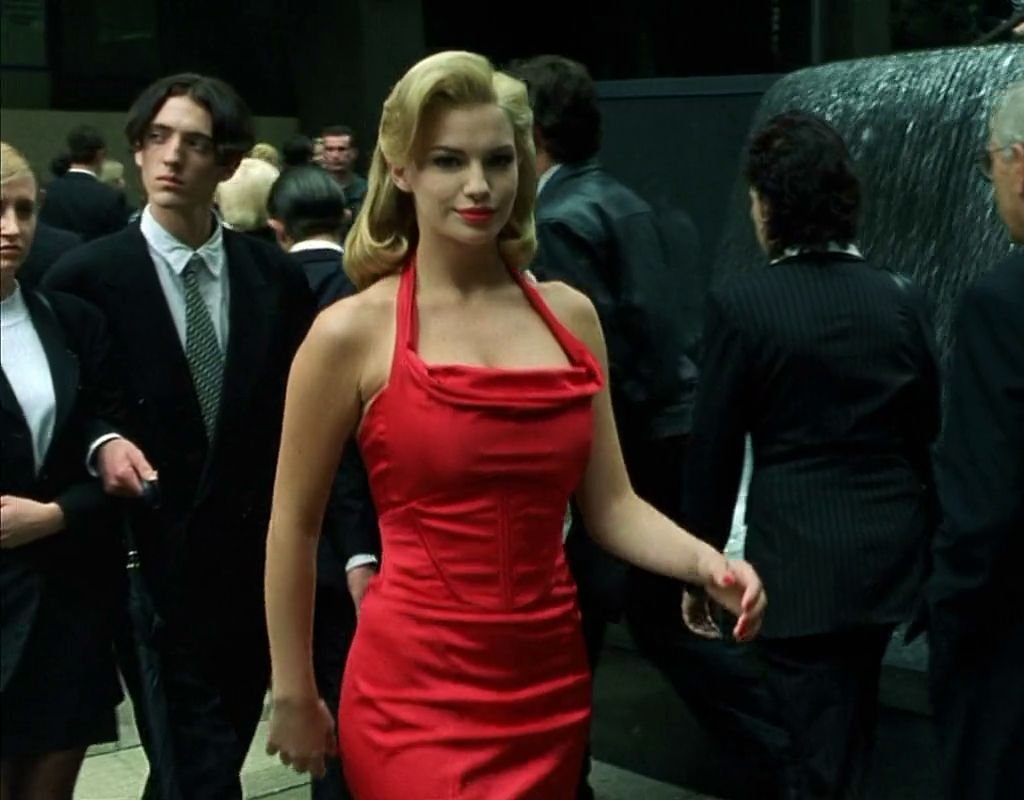
And right in the middle of his speech, a woman in a red dress struts past. She’s beautiful, impossible not to notice. Neo stares. But looks away for a split second and when he turns back—there’s an agent with a gun in his face.
Morpheus snaps at him: “Were you listening to me, Neo, or were you looking at the woman in the red dress?”
That line hit me in the gut.
The lesson is evident.
Distraction kills.
All these years later, I know that The Matrix was more than a fictional story, it was a warning, a foreshadowing for the digital tsunami coming our way. I didn’t know it then, but the woman in the red dress was—and still is—social media.
Gorgeous. Seductive. Alluring. Her function is to appear harmless. But she’s not harmless at all. In fact, she’s dangerous. She is a simulated character and a notable feature in the Agent training program. She’s an undercover operative pointing a gun at your face.
When we can train ourselves to see the woman in the red dress for what she really is—a loaded gun in your face— the exigency to unplug becomes imminent.
The tech-oligarchs materialized the Matrix—an attention driven world— that snugs into the palm of your hand, manipulating its users with cheap dopamine that hits our brain like the high from designer drugs.
The numbers are ugly. Americans spend over 1,300 hours a year on social media. That’s two months of life—every year. 1
Teenagers are worse. Seven hours a day on average. Gen Z? Nine hours. Nine hours! A full-time job, except the paycheck is anxiety, wasted time, and FOMO.2
When I was fourteen, I was riding bikes until the streetlights came on. Playing stickball with my friends. We had to be dragged inside. Now I see kids slouched on the couch, scrolling, scrolling, scrolling. Childhood traded for algorithms.
And I’m not judging them, because I’ve done it too.
Here’s what I noticed in myself: my attention was shot. I’d sit down to read a book, and halfway through the first chapter, I’d catch myself reaching for my phone, like a junkie checking for a fix.
It scared me. Because I love getting lost in books. Whole afternoons swallowed up by a novel. But back when I was hooked on social media, five pages and I was twitching.
There’s an experiment from the seventies—the Marshmallow Test.3. Kids could eat one marshmallow now, or wait fifteen minutes and get two. The kids who waited generally went on to do better in life. Proving that delayed gratification was an indicator for success.
Guess what we’re doing when we’re gallivanting with the woman in the red dress? We are practicing distraction, training the mind for immediate reward, and making ourselves great at instant gratification, which is self destruction because hard things, everything of value, requires intense focus and discipline.
Social media is the opposite of that. It trains you to take the marshmallow every time. Don’t wait. Don’t think. Just click. Scroll. Click.
Even celebrities—people whose entire careers depend on being seen, are backing away. Tom Holland said he had to quit Instagram because it was wrecking his mental health. Jonah Hill admitted social media fed years of anxiety.
If people with money, fame, and teams of managers can’t handle it, what chance do the rest of us have? How about kids?
And then there are parents giving in to this online identity cult.
I read about one mom who created Instagram accounts for her toddlers so they’d have their names reserved at eighteen. Imagine that, your inheritance is a digital addiction. Seems bizarre.
It feels like childhood itself is being colonized before it even starts.
Morpheus called the Matrix a prison for the mind. That’s what our phones have become. A prison we carry in our pockets. A prison we pay for.
I’ve felt it most at night. Lying in bed, the blue light glowing on my face, scrolling long past midnight. My wife asleep next to me, the world quiet, and me, wired, restless, burning time I’ll never get back.
Social Media is free and doesn’t seem to cost anything. But if you’re catching on, things aren’t as they seem. Social Media is a thief of time, and a thief of time is a thief of life.
And isn’t life what it’s all about? Isn’t time our most valuable resource? It cannot be retrieved, replaced, reproduced. Once it’s gone, it’s gone. Social media fixates us on an algorithm. A mathematical calculation engineered to tug at our individual emotions. A trojan horse virus that infects and exploits our emotions, relationships, family, religion, hobbies, politics, and just about anything we show interest in.
An engineered woman in a red dress for Neo, a dachshund jumping into a swimming pool for me, maybe a motivational speech by Al Pacino for you. But the gun is pointed at all of us.
For those of us fortunate enough to have unplugged from The Social Media Matrix, we can see the simulation for what it is, an attention driven war where the soldiers don’t understand they’re on a battlefield.
The soldiers are taking gunfire from armor piercing rounds and holding up umbrellas because they think it’s raining.
In warfare, leverage is optimal. But we’ve lost the high ground—handing over our attention and concentration whilst giving the enemy intelligence—valuable personal input to be used against us like Matrix Kung Fu.
So what’s the way out?
Afterall, there’s a difference between knowing the path and walking the path.4
I don’t have all the answers. It took me a long time to quit social media even when I knew it was a scam. Some days I’d fail. Some days I’d win. But I knew this: I didn’t want to live as a slave to the woman in the red dress.
Every time I leave the phone in another room. Every time I sit and read without checking notifications. Every time I write instead of scroll, it feels like rebellion. Small, maybe. But real.
Morpheus told Neo he had a choice: blue pill or red pill. Stay plugged in, or wake up.
I think we all face that same choice, every day.
And I don’t want to die staring at a screen, mistaking the woman in the red dress for something real.
Life is too short and too precious.
There are too many tunnels to explore.
Source:
Leave a Reply